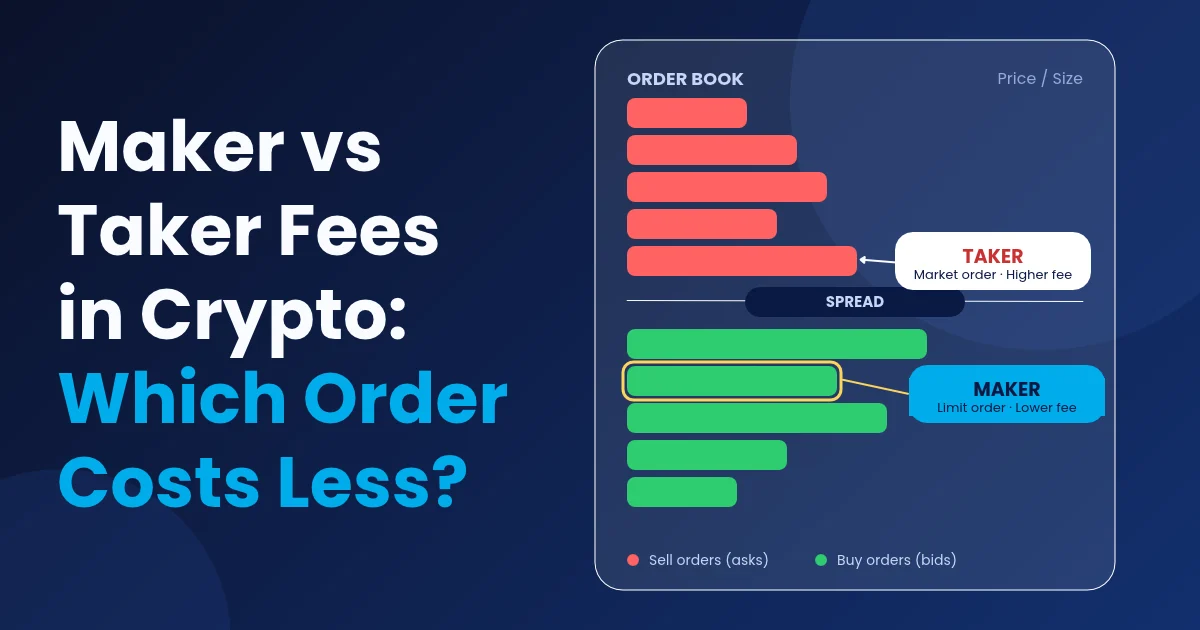
- Limit orders that rest on the order book (makers) almost always pay lower fees than market orders that fill instantly (takers).
- Makers add liquidity and get rewarded with cheaper rates (sometimes 0%); takers remove liquidity and pay higher fees for speed.
- The fee gap is much larger on futures/perpetuals (often 2.5x–4x) than on spot markets.
- Use limit orders + enable Post-Only (Maker-Only) mode on any major exchange.
- Hold exchange tokens (BNB, etc.), increase volume for better tiers, and compare platforms regularly to keep crypto trading costs as low as possible.
Maker orders almost always cost less than taker orders in crypto trading. When you place a limit order that rests on the order book and adds liquidity, you pay the lower maker fee (sometimes even zero or a small rebate).
Market orders or aggressive limit orders that fill immediately remove liquidity and trigger the higher taker fee. Understanding this simple difference is the fastest way to cut your crypto trading fees and keep more of your profits.
What Are Maker and Taker Fees? A Beginner-Friendly Explanation
Most modern crypto exchanges use a system called the maker-taker fee model. This model is designed to keep markets healthy by rewarding people who help create liquidity and charging a premium to those who need instant execution.
Think of the order book as a marketplace notice board. Buyers post the prices they are willing to pay, and sellers post the prices they are willing to accept. When these prices match, a trade happens.
A maker is the person who posts a new price on that notice board that is not immediately matched. Their order sits there waiting. By doing this, they add more options for other traders. Exchanges like this behavior because a deeper order book means tighter spreads, less price slippage, and a better experience for everyone. That is why maker fees are lower.
A taker is the person who takes an existing offer from the notice board right away. They do not wait. They accept the best available price and the trade happens instantly. Because they remove liquidity from the book, exchanges charge them a higher taker fee.
In everyday language:
Maker = You help the market → lower fee
Taker = You take from the market → higher fee
This is the foundation of what maker and taker fees are and how maker and taker fees work.
The classification depends on how the order actually fills, not only on the button you click. A market order is almost always a taker order. A limit order can be either maker or taker depending on whether it rests on the book or fills immediately.
Maker Fee vs Taker Fee: Detailed Side-by-Side Comparison
Here is a clear breakdown that shows the practical differences:
|
Feature |
Maker Order |
Taker Order |
|
Liquidity role |
Adds liquidity to the order book |
Removes liquidity from the order book |
|
Typical order type |
Limit order that does not fill instantly |
Market order or limit order that crosses the spread |
|
Execution speed |
Delayed – waits for a match |
Instant |
|
Fee level |
Lower (often 0% to 0.10%) |
Higher (often 0.05% to 0.80% or more) |
|
Certainty of fill |
Not guaranteed |
Guaranteed (at current market price) |
|
Impact on order book |
Increases depth and can tighten spreads |
Decreases depth |
|
Best used for |
Non-urgent entries and exits |
Urgent trades, stop-losses, news events |
|
Possibility of rebate |
Yes, at higher volume tiers on some exchanges |
Rarely |
On futures markets, the difference is usually larger. Taker fees are often 2.5 to 4 times higher than maker fees at the same volume tier.
Real-World Fee Comparison Across Major Exchanges (2026 Data)
Fee rates change with trading volume, holding of exchange tokens, and promotions. The table below shows typical entry-level (lowest volume tier) rates for regular users. These figures come from public fee schedules and independent comparisons.
|
Exchange |
Spot Maker / Taker |
Futures Maker / Taker |
Key Advantage / Note |
|
Binance |
0.10% / 0.10% |
0.02% / 0.05% |
25% discount if fees are paid in BNB |
|
OKX |
0.08% / 0.10% |
0.02% / 0.05% |
Strong volume-based discounts |
|
Bybit |
0.10% / 0.10% |
0.02% / 0.055% |
Competitive futures rates |
|
Bitget |
0.10% / 0.10% |
0.02% / 0.06% |
Similar structure to Bybit |
|
MEXC |
0% / 0.05% |
0% / 0.02% |
Frequently offers zero maker fees |
|
Gate.io |
0.10% / 0.10% |
0.02% / 0.05% |
Wide selection of coins |
|
Kraken Pro |
0.40% / 0.80% |
Varies by pair |
Higher starting fees, drops with volume |
|
Coinbase Advanced |
0.40%–0.60% / 0.60%–1.20% |
Higher |
Higher for smaller accounts |
These numbers show why searching for the best crypto exchange with lowest fees, lowest fee crypto exchange, or crypto exchange with lowest fees is so common. Platforms like MEXC stand out with MEXC zero maker fee options, while Binance and OKX become very competitive once you factor in token discounts and volume tiers.
Why Maker Orders Are Cheaper - The Logic Behind the Model
Exchanges make money mainly from trading volume and the fees collected on that volume. A deep and active order book attracts more traders, which creates more volume. Makers help build that depth. Without enough makers, the order book becomes thin, spreads widen, and large orders move the price a lot. This scares away both retail and professional traders.
By offering lower maker fees(and sometimes rebates), exchanges encourage more people to post resting orders. Takers pay the higher rate for the convenience of immediate execution. This balance keeps the market functioning smoothly.
The savings become meaningful when you trade regularly. Consider a simple example on futures with a 0.02% maker fee and 0.05% taker fee:
- Trade size: $50,000
- Maker fee: $10
- Taker fee: $25
If you make 30 similar trades in a month:
- All-taker cost: $750
- All-maker cost: $300
- Difference: $450 saved in one month
Over a full year, the gap can reach several thousand dollars, even for moderate traders. This is why questions like which is cheaper, maker or taker fees, and maker vs. taker, which order costs less, matter so much for long-term results.
How to Consistently Pay Maker Fees (Step-by-Step Guide)
You do not need advanced skills to favor maker fees. Follow these practical steps:
1. Switch from market orders to limit orders
Always prefer limit orders. Place your buy limit slightly below the current best ask, or your sell limit slightly above the current best bid. This gives the order a high chance of resting on the book.
2. Turn on Post-Only (Maker-Only) mode
Almost every major exchange offers this setting. When enabled, the system cancels or rejects the order if it would fill immediately as a taker. This is the most reliable way to answer how to pay only maker fees in crypto. Look for buttons labeled “Post Only”, “Maker Only”, or “Add Liquidity Only”.
3. Use the advanced trading interface
The simple “Buy” or “Sell” buttons on many apps often route as taker orders or include hidden spreads. Switch to the full order-book interface for better control.
4. Monitor partial fills
Sometimes only part of a large order fills immediately (taker portion) while the rest rests on the book (maker portion). The exchange charges the correct fee for each part. Breaking large orders into smaller pieces can increase the maker share.
5. Choose the right market conditions
In high-volume pairs like BTC/USDT or ETH/USDT, limit orders fill reasonably fast. In low-liquidity altcoins, the wait can be longer, so adjust your expectations.
These habits form a complete system for how to reduce crypto trading fees without changing your overall strategy.
Spot vs Futures: Where the Biggest Savings Happen
On spot markets, many exchanges charge the same rate for makers and takers at the lowest volume tier (for example, 0.10%/0.10% on Binance). The advantage of maker orders grows mainly when you reach higher volume tiers or use token discounts.
On futures and perpetual contracts, the gap is usually much wider. Maker fees of 0.01%–0.02% versus taker fees of 0.04%–0.06% are common. Active traders who open and close positions frequently see the largest benefit from using maker orders on futures. This is why spot vs futures maker-taker fees and futures trading fees are important topics for anyone trading with leverage.
Additional Ways to Lower Your Overall Crypto Trading Costs
Even after mastering maker orders, several other levers exist:
- Hold the exchange’s native token (BNB, OKB, BGB, MX, etc.) for automatic fee discounts of 10–25%.
- Build 30-day trading volume to unlock better fee tiers. Higher volume almost always means lower rates for both makers and takers.
- Compare platforms regularly. The ranking of the best low-fee crypto exchange 2026 changes with promotions and volume incentives.
- Use free online tools such as a crypto exchange fee calculator before placing large trades.
- Avoid the simple “Instant Buy” interfaces. These often include wide spreads that cost more than the stated trading fee.
Realistic Cost Example Over One Year
Assume a trader averages $150,000 in monthly futures volume:
- Pure taker strategy at 0.05%: $75 per month → $900 per year
- 70% maker / 30% taker mix (0.02% / 0.05%): roughly $40.50 per month → about $486 per year
- Annual savings: over $400.
At higher volumes, the difference becomes even more significant. This is the practical reason traders care about crypto trading costs and actively look for ways to optimize them.
Common Mistakes That Increase Fees Unnecessarily
- Clicking the market order button out of habit
-
Ignoring the Post-Only option
-
Trading only on the simplified mobile interface
-
Not checking whether the pair has different maker and taker rates
-
Focusing only on the headline fee and forgetting volume tiers and token discounts
-
Using maker orders in extremely fast-moving markets where the risk of not filling is too high.
Avoiding these mistakes is one of the easiest improvements any beginner can make in crypto trading.
Conclusion
The clear answer to maker vs. taker, which order costs less, is that maker orders cost less in the large majority of situations. By consistently using limit orders, enabling Post-Only mode, and choosing platforms with competitive maker rates (including those offering zero maker fees), traders can meaningfully reduce their crypto trading fees.
Fees are one of the few variables in trading that you can control completely. Small, consistent improvements compound across hundreds of trades and can make a noticeable difference to long-term results. Start with the basics - switch to limit orders and turn on Post-Only - then refine further with volume tiers and token discounts.
Whether you are comparing Binance maker-taker fees, searching for the lowest trading fees crypto, or simply trying to understand maker fee vs taker fee, the principle remains the same: add liquidity when you can, take liquidity only when you must.
(Sources: Bankrate, Mudrex, Omen, Blofin)


Any question or suggestion
Post your Thoughts
Your email address will not be published. Required fields are marked *