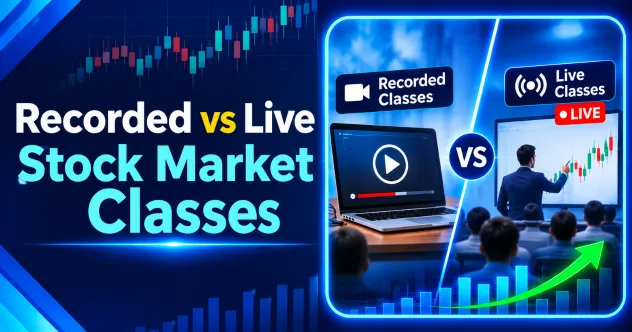
- Offer flexibility, lower costs, and unlimited revisions, making them suitable for self-disciplined learners.
- Provide real-time doubt clearing, practical market examples, mentor interaction, and better learning discipline.
- Beginners generally benefit more from live classes because they receive guidance and immediate feedback.
- Combining recorded lessons with live sessions offers the best of both worlds: flexibility, practical learning, and continuous support.
- Check the curriculum, mentor support, live sessions, risk management training, and student feedback. Avoid courses promising guaranteed profits.
A live stock market course or live stock trading course usually delivers better results than a purely recorded one because you get real-time feedback, current market examples, and accountability. Recorded lessons work well for flexibility and revision, but the strongest outcomes come from a hybrid approach of structured recorded content plus live sessions. If you are just starting, prioritize interaction over pure self-paced videos.
Choosing the right format can make the difference between understanding charts and actually trading with confidence. Many people search for a stock market course, share market course, or stock market classes and get confused by the options. This guide breaks down recorded versus live formats in simple language so you can decide what fits your life and learning style.
What Is a Recorded Stock Market Course?
A recorded stock market course online consists of pre-made video lessons you watch whenever you want. You can pause, rewind, and replay as many times as needed. These are often sold as lifetime-access packages and appear under labels like trading courses online or online stock market courses.
Advantages of recorded courses:
- Complete flexibility - study early morning, late night, or on weekends.
- Lower cost in many cases.
- Ability to revisit tough topics (candlesticks, support and resistance, risk management) until they click.
- Good starting point if you already have some basic knowledge.
Limitations:
- Content can become outdated as markets change.
- No immediate answers when you get stuck.
- It's easy to lose motivation without fixed schedules or a mentor watching your progress.
- You mainly see historical charts, not today’s live price action.
Many institutes still promote recorded libraries as the main product because they scale easily. However, students who only watch videos often struggle when they move to real trading.
- What Is a Live Stock Market Course?
A live stock market course or live stock trading course happens in real time on Zoom or a similar platform. The instructor teaches while the market is open (or in scheduled evening sessions), answers questions on the spot, and often shows live charts.
Advantages of live classes:
- Real-time doubt clearing.
- Current market examples instead of old screenshots.
- Built-in discipline through fixed class timings.
- Peer learning allows you to hear other students’ questions and see different perspectives.
- Better preparation for the emotional side of trading because the teacher models decisions live.
Limitations:
- Less flexibility you must attend at set times.
- Usually higher fees.
- If you miss a session, you depend on the recording (if provided).
Live formats shine for beginners who need structure and accountability. Research and practitioner experience show that interactive teaching leads to stronger skill retention than passive video watching.
Explore Finowings Technical Analysis live course.
Side-by-Side Comparison
|
Factor |
Recorded Course |
Live Course |
Winner for Most Beginners |
|
Flexibility |
Excellent (any time) |
Limited (fixed schedule) |
Recorded |
|
Real-time interaction |
None or limited Q&A |
High (chat + mic) |
Live |
|
Market relevance |
Historical examples |
Current market moves |
Live |
|
Discipline & motivation |
Depends fully on you |
Fixed timings help |
Live |
|
Cost |
Usually lower |
Higher |
Recorded |
|
Revision |
Easy (rewatch anytime) |
Depends on whether recordings are given |
Recorded |
|
Best for |
Self-motivated learners, busy schedules |
Beginners needing guidance & accountability |
Live |
This table shows why pure recorded content often falls short for new traders, while live sessions close the gap between theory and practice.
Who Should Choose a Recorded Course?
Choose a recorded stock market course if:-
- Your work or family schedule is unpredictable.
- You already understand basic concepts and mainly need structured material for revision.
- Budget is the biggest constraint and you can stay disciplined on your own.
- You want to combine free resources (YouTube, free stock market course materials, free trading courses) with paid videos.
Many people start with free content and later upgrade. A pure recorded path works best when paired with a strong personal routine and a trading journal.
Who Should Choose a Live Stock Market Course?
A live stock market course or classes in stock market suits you if:-
- You are a complete beginner and need step-by-step guidance.
- You lose focus watching videos alone.
- You want to ask questions the moment confusion arises.
- You value seeing how a mentor handles today’s market conditions.
- You prefer the energy of a group learning environment.
Live formats also help with trading psychology. Watching a teacher stay calm during volatility teaches more than any slide deck.
Explore Finowings Recorded courses.
The Hybrid Approach - Often the Best Stock Market Course Format
- The highest-performing students usually combine both. Many quality programs now offer:
Recorded modules for theory and fundamentals. - Live classes for practice, chart work, and doubt sessions.
- Recordings of the live sessions for later revision.
This “best of both worlds” model appears frequently in modern stock trading courses and courses on stock market. You get the structure of recorded lessons plus the relevance and support of live interaction.
How to Pick the Best Stock Market Course for You
When evaluating any best stock market course or stock market course online, ask these questions:
1. Does it include live sessions or only recorded videos?
2. Are the live classes conducted while the market is open (or close to market hours)?
3. Will you get access to recordings of the live sessions?
4. Is there ongoing mentorship or a community after the main course ends?
5. Does the curriculum cover risk management and psychology, not just patterns?
6. Can you see sample lessons or student reviews that talk about real results?
Avoid programs that promise guaranteed profits. Focus on skill-building. A good share market course or classes for the stock market should teach you how markets work, how to manage risk, and how to develop a personal process.
Practical Tips for Beginners
- Start with free resources to test your interest. Many platforms offer a free stock market course or short free trading courses.
- Once you decide to invest, prefer programs that mix recorded and live elements.
- Treat the course like a gym membership; consistency matters more than the perfect video library.
- Keep a simple notebook: note what you learned each session and one action you will practice.
- Paper trade (simulate trades without real money) while you learn. This bridges the gap between class and real capital.
Common Mistakes to Avoid
- Buying the cheapest recorded course and never finishing it.
- Joining a live batch and missing most sessions because of poor time management.
- Expecting the course alone to make you profitable. Education is only the foundation; practice and review do the rest.
- Ignoring psychology and risk management modules.
Conclusion
For the majority of beginners, a live stock market course or a well-designed hybrid program delivers better results than a purely recorded one. Live interaction keeps you accountable, shows current market behavior, and allows instant clarification. Recorded content remains valuable for revision and flexibility.
If your schedule is extremely tight, begin with a high-quality recorded online stock market course and add live Q&A or community support later. The goal is not the format itself, it is becoming a disciplined, knowledgeable trader.
Choose the path that matches your current stage, commit fully, and focus on the process over short-term results. Markets reward consistent learners more than those who only collect certificates.
(Sources:
live-trading-education-vs-recorded-courses
live-trading-room-vs-recorded-courses
online-vs-offline-stock-market-course-which-learning-mode-is-better)


Any question or suggestion
Post your Thoughts
Your email address will not be published. Required fields are marked *